Full service capability

Our Capabilities

Our Capabilities

From sample receipt
to client-ready data.

From sample receipt
to client-ready data.

Sample preparation, funnel and centrifuge heavy liquid separation, laboratory QA/QC, and specialist services such as centrifuge optimisation — applied across different deposit styles.

Sample preparation, funnel and centrifuge heavy liquid separation, laboratory QA/QC, and specialist services such as centrifuge optimisation — applied across different deposit styles.

Core offering
Core offering

End-to-End Separation Capability.

End-to-End Separation Capability.

Integrated laboratory workflows designed for precision, traceability, and reliable recovery — covering sample preparation, heavy liquid separation, reporting, and specialist services.

Integrated laboratory workflows designed for precision, traceability, and reliable recovery — covering sample preparation, heavy liquid separation, reporting, and specialist services.

Sample Preparation.

From receipt to separation-ready — controlled, documented, reproducible.

Sample receipt and verification with digital tracking.

Controlled oven drying of wet or damp samples prior to further processing.

Disaggregation and jaw crushing of coarse or cemented material.

Precision sample splitting for representative subsampling.

Sample soaking using dispersants (TSPP, TKPP, Calgon) and digital overhead stirrers.

Wet sieve screening (desliming) using electromagnetic shaker systems, at a project-specified deslime cut.

Oversize screening at a project-specified top cut size prior to separation.

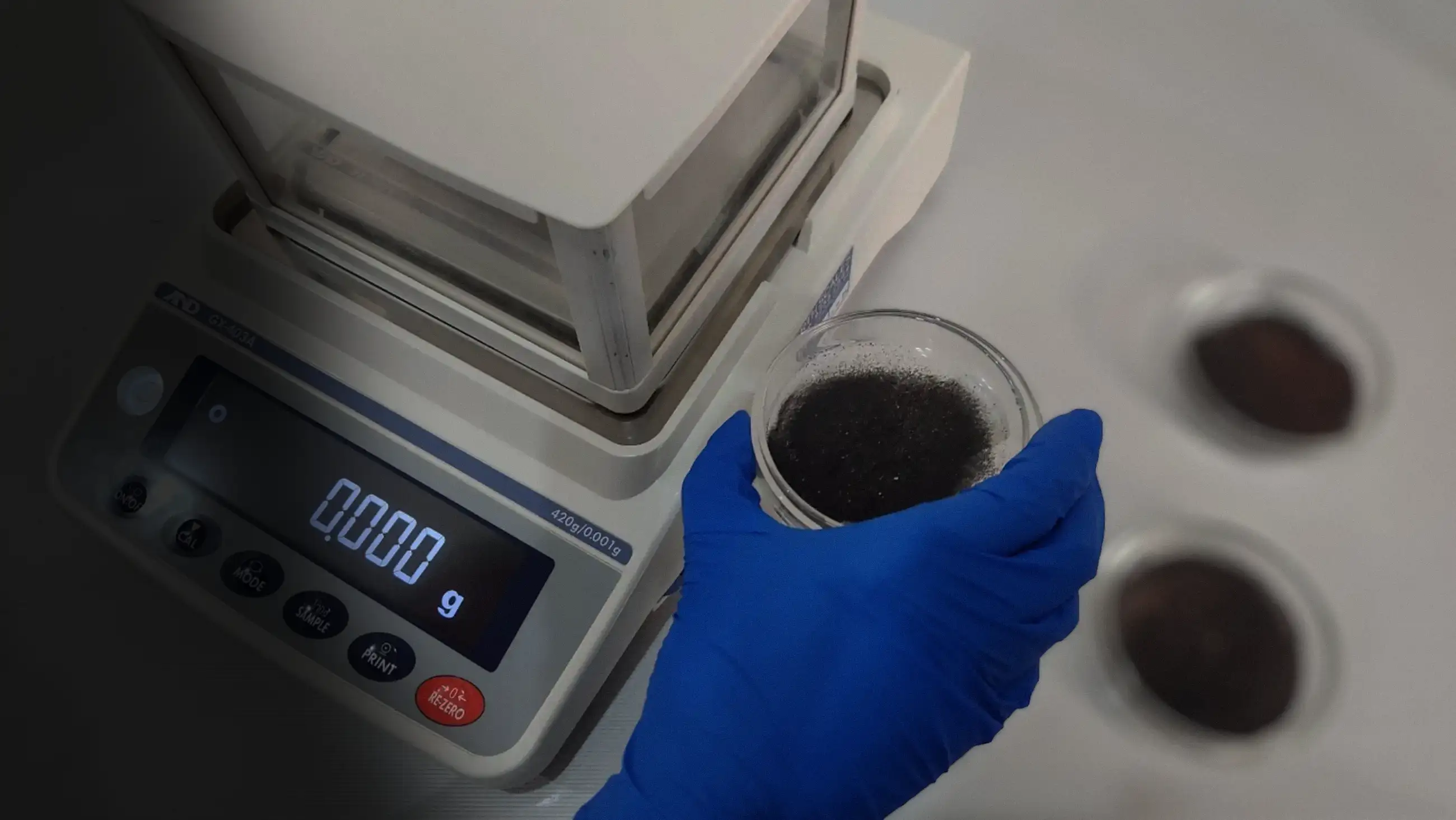
High-precision digital weighing integrated into data capture workflows.

Filter press dewatering to retain the fine (slimes) fraction, available on request.

Planned

Heavy Liquid Separation.

Funnel-based and centrifuge workflows — each applied where appropriate.

Heavy liquid separation using tetrabromoethane (TBE, SG ~2.96) — currently the medium in use across all workflows.

Static funnel separation — effective where the deslime cut is 38 µm or coarser.

Large centrifuge separation (sample mass ~100 g) for programs where the deslime cut goes below 38 µm.

Small centrifuge (up to ~25 g) for fine fraction analysis across targeted sub-38 µm intervals.

Fine fraction separation to 15 µm — available for testwork and smaller batch programs, scale-up ongoing.

Centrifuge separation of the retained slimes fraction for heavy mineral recovery.

Planned

LST heavy liquid medium — a planned addition supporting a safer, more sustainable separation process.

Planned

Reporting & Data Delivery.

Transparent, traceable, and verified at every step.

Blanks, reference materials, and duplicates embedded in every workflow, at an insertion rate adjusted to client requirements.

Laboratory QA/QC results, mass balance verification, and internal batch review — monitoring and controlling laboratory performance.

Transparent fraction reporting for every batch.

Customised data deliverables aligned with client reporting requirements.

Project progress tracking — batch status and turnaround visibility through the program.

Planned

Additional Services & Support

Optional and available on request.

Centrifuge optimisation — deposit-specific testwork to establish the settings that deliver the best recovery, available as a detailed study or abbreviated assessment.

Testwork to identify the optimal deslime cut, soaking procedure, or dispersant for a deposit, ahead of full-scale separation.

Guidance for clients deciding on workflow design or split size ahead of their separation program.

Residue storage or environmentally responsible disposal.

Training in mineral sands panning and field sampling techniques.

Rig geologist coverage for drill programs, available on request.
lab sand
Quality & Modernisation

Improving continuously — and openly.

Improving continuously — and openly.

Since the October 2025 change of ownership, the laboratory has invested in new equipment, documented workflows, and expanded capability.

Since the October 2025 change of ownership, the laboratory has invested in new equipment, documented workflows, and expanded capability.

Laboratory modernisation — instrumentation, systems & workflows

With the change of ownership, the laboratory has undergone a comprehensive overhaul. Workflows are now fully documented, and QA/QC systems have been strengthened, supported by a cloud-based platform with digital data capture on toughbooks at every station. New equipment includes high-precision digital scales, certified sieves across a range of screen sizes, new riffle splitters matched to particle size for representative sampling, added soaking capability, digital overhead stirrers, electromagnetic sieve shakers, and new funnel equipment, alongside broader upgrades to lab fit-out and storage. Processing rate has increased, and the team has grown to >10 staff.

Centrifuge HLS — acquisition & methodology development

Under new ownership, separation capability has expanded: a large and a small centrifuge have been commissioned alongside a purpose-built methodology, complementing established funnel-based separation. Supported by dedicated QA/QC protocols and deposit-specific optimisation, the centrifuges routinely separate to 20 µm, with capability to 15 µm for test work and smaller batches. Planned expansion includes centrifuge separation of the retained slimes fraction, for additional heavy mineral recovery.

Centrifuge HLS — acquisition & methodology development

Under new ownership, separation capability has expanded: a large and a small centrifuge have been commissioned alongside a purpose-built methodology, complementing established funnel-based separation. Supported by dedicated QA/QC protocols and deposit-specific optimisation, the centrifuges routinely separate to 20 µm, with capability to 15 µm for test work and smaller batches. Planned expansion includes centrifuge separation of the retained slimes fraction, for additional heavy mineral recovery.

Lab expansion and upgrades

A new, purpose-built facility is being actively planned for 2027, supporting the next phase of laboratory capability. In the meantime, modernisation continues at the current site, with an automated digital sample splitter being commissioned this year and optical mineral identification introduced through 2026–2027. The new facility will enable further capability, including advanced mineral identification, and the introduction of a more sustainable heavy liquid medium, alongside progress towards quarantine approval. The laboratory is also working towards future ISO accreditation, and client input on additional capabilities is always welcome.

Planned 2026-2027
lab sand
Quality & Modernisation

Improving continuously — and openly.

Since the October 2025 change of ownership, the laboratory has invested in new equipment, documented workflows, and expanded capability.

Laboratory modernisation — instrumentation, systems & workflows

With the change of ownership, the laboratory has undergone a comprehensive overhaul. Workflows are now fully documented, and QA/QC systems have been strengthened, supported by a cloud-based platform with digital data capture on toughbooks at every station. New equipment includes high-precision digital scales, certified sieves across a range of screen sizes, new riffle splitters matched to particle size for representative sampling, added soaking capability, digital overhead stirrers, electromagnetic sieve shakers, and new funnel equipment, alongside broader upgrades to lab fit-out and storage. Processing rate has increased, and the team has grown to >10 staff.

Centrifuge HLS — acquisition & methodology development

Under new ownership, separation capability has expanded: a large and a small centrifuge have been commissioned alongside a purpose-built methodology, complementing established funnel-based separation. Supported by dedicated QA/QC protocols and deposit-specific optimisation, the centrifuges routinely separate to 20 µm, with capability to 15 µm for test work and smaller batches. Planned expansion includes centrifuge separation of the retained slimes fraction, for additional heavy mineral recovery.

Lab expansion and upgrades

A new, purpose-built facility is being actively planned for 2027, supporting the next phase of laboratory capability. In the meantime, modernisation continues at the current site, with an automated digital sample splitter being commissioned this year and optical mineral identification introduced through 2026–2027. The new facility will enable further capability, including advanced mineral identification, and the introduction of a more sustainable heavy liquid medium, alongside progress towards quarantine approval. The laboratory is also working towards future ISO accreditation, and client input on additional capabilities is always welcome.

Planned 2026-2027

Years of Experience

36+

Three decades of heavy mineral laboratory operation in Western Australia — a track record being built on, not replaced.

Funnel HLS Separation

≥38µm

Static heavy liquid separation for deslime cuts at 38 µm or coarser.

Centrifuge HLS Separation

≤20µm

Centrifuge heavy liquid separation for deslime cuts at 20 µm for routine work, or 15 µm for test work.

Years of Experience

36+

Three decades of heavy mineral laboratory operation in Western Australia — a track record being built on, not replaced.

Funnel HLS Separation

≥38µm

Static heavy liquid separation for deslime cuts at 38 µm or coarser.

Centrifuge HLS Separation

≤20µm

Centrifuge heavy liquid separation for deslime cuts at 20 µm for routine work, or 15 µm for test work.

Years of Experience

36+

Three decades of heavy mineral laboratory operation in Western Australia — a track record being built on, not replaced.

Funnel HLS Separation

≥38µm

Static heavy liquid separation for deslime cuts at 38 µm or coarser.

Centrifuge HLS Separation

≤20µm

Centrifuge heavy liquid separation for deslime cuts at 20 µm for routine work, or 15 µm for test work.